For pool and outdoor contractors
Certification for pool and outdoor contractors
Approvals and inspections for pools, safety barriers, decks, pergolas, sheds and retaining walls, with a clear answer on what each structure needs.
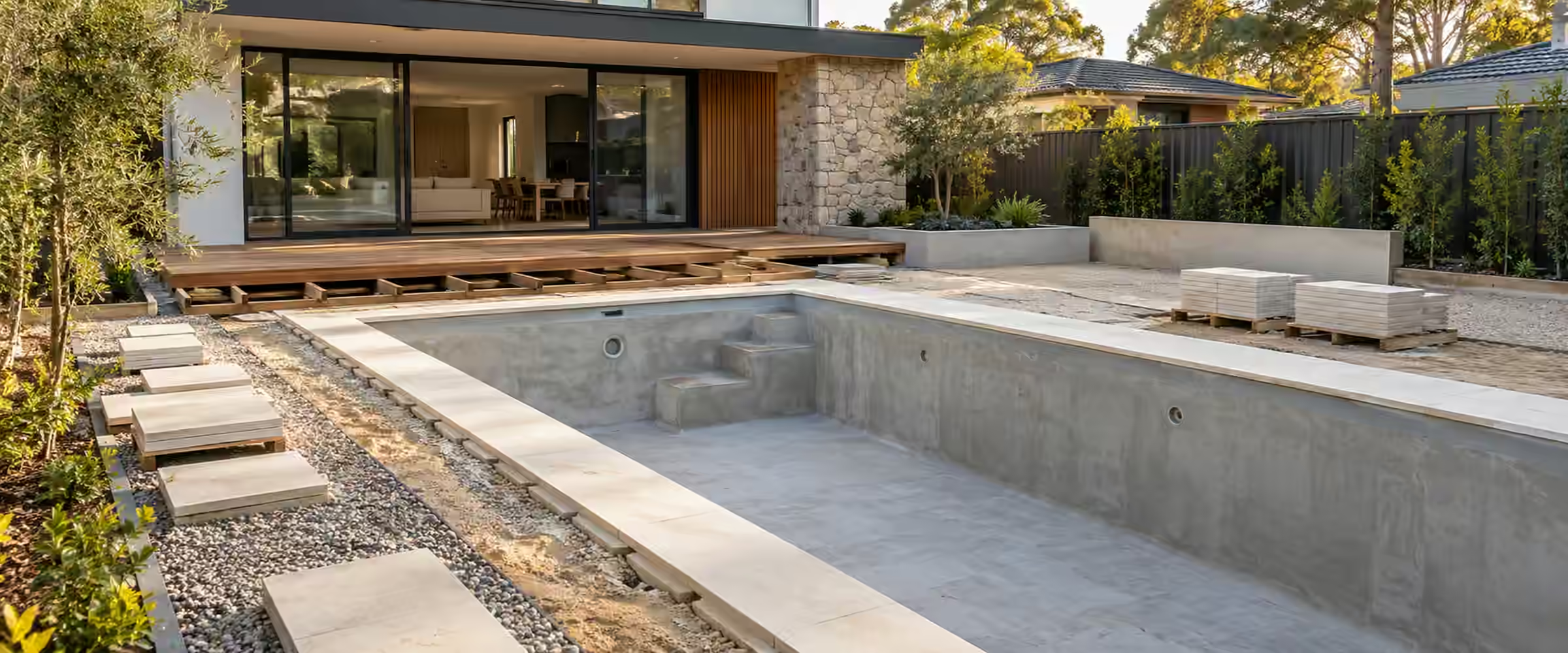
Class 10 work
Even small structures need proper sign-off
Some outdoor work is exempt, so no approval applies. Everything else must be approved, by CDC or by DA. We test the exempt standards first, so your client pays for approval only when it is actually required.
With pools, the child-safety barrier is the main concern. We inspect it after it goes up and before any water goes in, and registration of the pool is also required.
Pool certificationExempt check first
No approval needed if every exempt standard is met.
Barrier inspection
Before filling begins.
Pool register
Registration is separate from certification.
Class 10
Pools, decks, sheds, carports and walls.
What to send
What to send us
The details depend on the structure. These cover most jobs.
- Site planLocation of the structure, setbacks and boundaries.
- LevelsExisting and finished levels, including around a pool barrier.
- EngineeringPool shell, deck framing or retaining wall design.
- Barrier layoutFence and gate locations, heights and non-climbable zones.
Working with us
A straight answer on approval.
Exempt, CDC or DA, confirmed before your client commits.
- Exempt standards checked first
- Barrier inspections booked promptly
- Written results
- Completion documents tracked
Pool projects
From approval to a pool in use.
The typical sequence when building an in-ground pool.
01
Approval
We settle the pathway, then issue the certificate when the pool, levels and barrier comply with the standards.
02
Construction
A temporary barrier is in place during the works, and the required stages are inspected.
03
Barrier and completion
We inspect the permanent barrier ahead of filling, and the occupation certificate is issued after that.
Common projects
Outdoor work we certify.
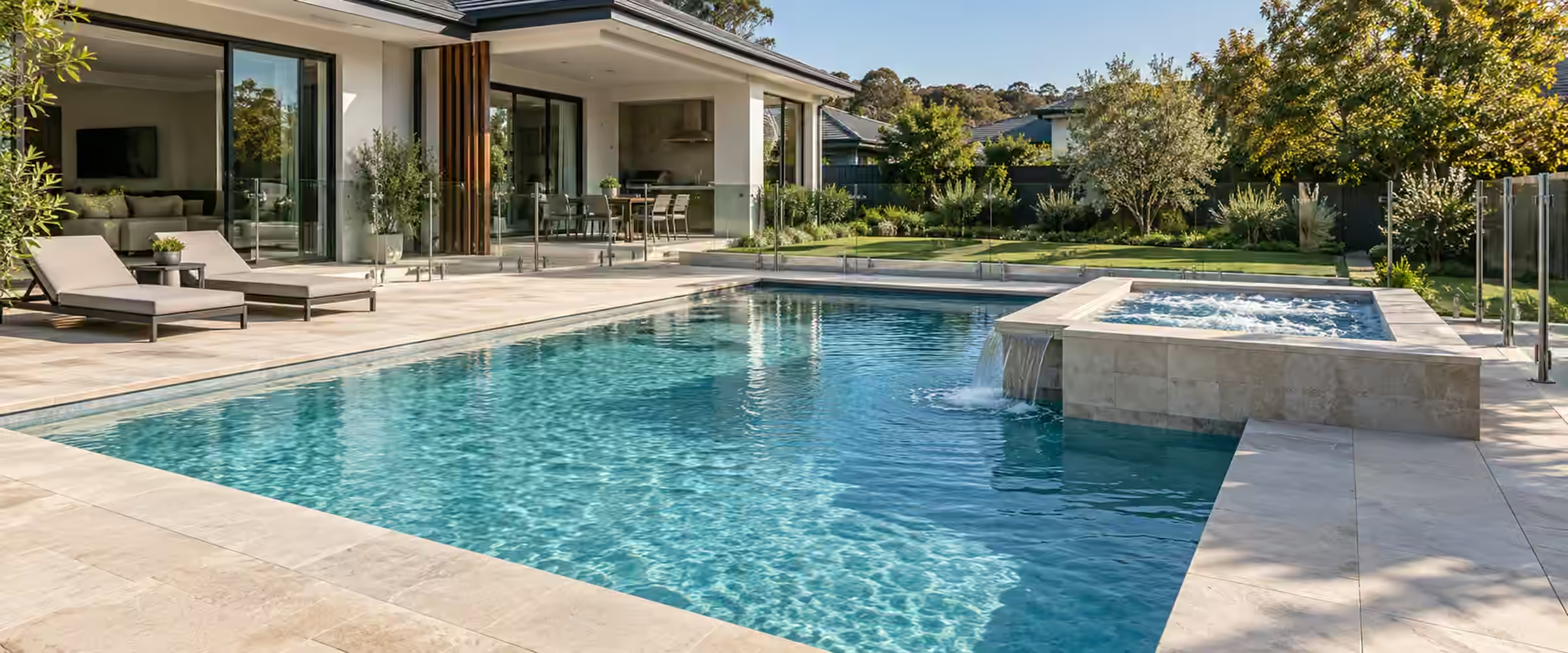
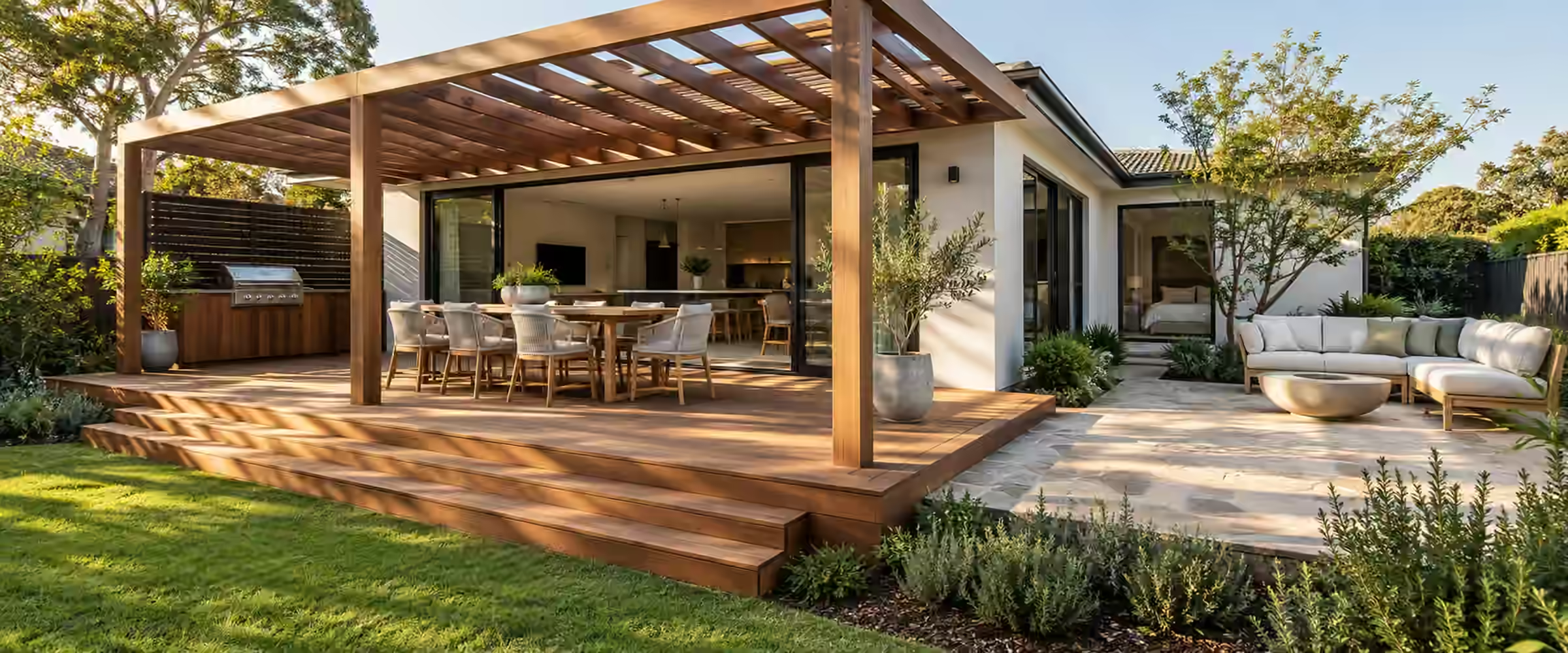
Two common project types. See every structure on our building types page.
Common issues
Where outdoor jobs fail inspection
The three most common problems at the final check.
Levels
Landscaping after the barrier
New paving or garden beds can reduce the effective fence height.
Gates
Self-closing and latching
A gate that does not close and latch on its own will not pass.
Height
Decks over the exempt limits
A raised deck can quickly fall outside the exempt standards and need approval.
For pool and landscape contractors
Licences, insurance and who looks after the pool fence
Pool and landscape contractors work under two sets of NSW rules. One covers licences and contracts. The other covers the pool barrier. Knowing who is responsible for what avoids gaps at handover.
Sources: NSW Government: Swimming pool building work licence; NSW Government: Structural landscaping work licence; SIRA: Contracting and home building compensation guidance for landscaping projects; NSW Government: your obligations as a pool or spa owner. General information only; requirements depend on your lot, design and approval.
Which licence covers the work?
Home building work valued above $5,000, counting labour and materials and including GST, requires a contractor licence. A swimming pool building licence lets you build, renovate, repair and maintain a pool, plus work linked to its installation, such as safety fencing, filtration, heating and associated landscaping. Spa pools fall under it; spa baths do not.
Structural landscaping is a separate licence. It covers retaining walls, fencing, driveways, paths and paving, pergolas, decks and cabanas. It also covers ponds and water features that need development approval. Plumbing, drainage and electrical work must go to a subcontractor licensed for it.
Licences and supervisor certificates last 1, 3 or 5 years. The current pool building qualification is CPC40820 Certificate IV in Swimming Pool and Spa Building. Unlicensed work can be fined up to $22,000 for a person and $110,000 for a company.
Contracts and insurance
Any contract above $5,000 has to comply with NSW home building law. Where the contract exceeds $20,000 including GST, home building compensation insurance must be in place. Soft landscaping (plants, turf, soil and garden beds) is generally not treated as building work and can be contracted separately.
For a staged project with the same customer, add the building contracts together for the $20,000 test. One policy then covers the whole project. If you work for an owner-builder, you still need cover over $20,000, because owner-builders cannot buy it for their own work.
Temporary fencing during the build
The NSW guidance for new pools is straightforward. Temporary child-resistant fencing stays up for the whole build. An inspection is booked as soon as the permanent barrier is installed. Nobody uses the pool before the occupation certificate is issued, and a sign must say so. Put in writing who erects, maintains and removes the temporary fence, and who confirms each day that it is closed.
What stays with the owner?
The owner carries the ongoing pool safety duties: registering the pool, keeping the barrier compliant and displaying a CPR sign legible at a distance of 3 m. Where an older barrier is altered or rebuilt, it has to comply with AS 1926.1-2012, so even relocating a gate on an older pool can trigger the current standard.
At handover, give the owner the barrier layout, gate hardware details and the occupation certificate. Remind them that registering the pool is their job. Fencing that forms part of the pool barrier counts as pool building work when it is tied to installing the pool, so the trade that builds it needs the right licence.
Which inspections does a pool job need?
Pools are Class 10 structures, and the standard critical stages apply wherever they occur on the job. For a concrete pool that means a visit once the hole is dug and before footings go in, and another before the reinforced shell is cast in place. Stormwater connections must be seen before they are buried.
Pools carry one extra stage of their own. Once the child safety barrier that the state pool law demands has been built, the certifier must inspect it without delay. Last comes the final inspection, which only the principal certifier may carry out.
Each call-up is the principal contractor's job, giving the principal certifier no less than 48 hours of warning. Fibreglass shells, steel wall pools and spas reach different stages, so read the inspection list in the certifier's notice at the start of every job rather than working from habit.
Pools over old mine workings
Before pricing a concrete pool in a coal mining area, check the property's Mine Subsidence District status. Subsidence Advisory NSW may have to approve the work, and its guidelines change with the kind of ground movement expected under the site.
On land where shallow old workings could open a pothole, Subsidence Advisory assesses the application itself. A concrete pool there must be backed by a structural engineer's certificate showing it remains usable if a hole 5 m across forms beneath it. Detached cabanas and garages, which are capped at 50 m² and cannot be lived in, need the same engineering sign-off.
On land exposed to trough subsidence, the guideline for compliant work permits concrete pools set into the ground and above it. Proposals that fit that guideline can be assessed by Subsidence Advisory, the council or a registered certifier. Some minor works need no subsidence approval at all, so check the exempt list before assuming either way.
Pumps, heaters and the neighbours
Pool pumps sit under the NSW neighbourhood noise rules. They must not be heard inside a neighbour's home from 8 pm to 8 am on Saturdays, Sundays and public holidays, or from 8 pm to 7 am on any other day.
Where the plant goes is a choice the owner lives with for years. Setting the pump and filter away from a neighbour's bedroom windows, or inside an acoustic enclosure, lets the owner run a timer without breaking those hours. Check the approval for any condition about where equipment must go, and show the location on the plans so it is assessed before it is installed.
Portable pools count too
NSW pool safety law reaches any pool or spa that can hold water more than 30 cm deep where there is a home on the land. Portable and blow-up pools that can be filled that deep must be fenced with a child-resistant barrier, carry a CPR sign and be registered, the same as a pool set into the ground.
Above-ground and portable units are often sold as simple products, but the barrier and registration rules still apply once they can hold enough water. Tell the client before delivery, so the fence is costed and planned alongside the pool, not as an afterthought.
The occupation certificate keeps working after handover. On a sale, the contract can include a relevant occupation certificate issued in the last 3 years, together with the registration certificate. An owner who leases the home can also rely on one. Hand it over with the barrier details so the owner can find it when needed.
More sources: NSW Legislation: Development Certification and Fire Safety Regulation 2021 (as made); Legal Aid NSW: Noise restrictions; NSW Government: Your obligations as a pool or spa owner; NSW Planning Portal: Exempt balconies, decks and patios; Subsidence Advisory NSW: Surface Development Guideline 1; Subsidence Advisory NSW: Surface Development Guideline 2. General information only; requirements depend on your lot, design and approval.
Your questions, answered
Questions from contractors.
What pool and outdoor contractors ask most.
Ask us about your projectWhen is it okay to fill the pool?
Only once the permanent barrier is finished and the certifier has inspected it. The regulation calls for that inspection promptly after the barrier goes up, and NSW guidance says nobody should swim in it until the occupation certificate is issued, with a sign on site saying so. Until then, keep the temporary child-resistant fence closed and secure. Filling before the barrier passes leaves deep water behind fencing that has not been approved, which is the very risk these rules exist to prevent.
Is pool registration the same as certification?
No. Registration is the owner's task on the state's online pool register, and it only records that a pool exists. The government states plainly that a registered pool is not necessarily a compliant one. Certification is separate: the principal certifier inspects the work and the barrier, then issues the occupation certificate for a new pool. For a sale or lease, the owner needs the registration certificate plus proof of compliance, such as a relevant occupation certificate or a current compliance certificate. Remind the owner to register at handover.
Does every deck or pergola need approval?
No. A deck or pergola that satisfies every exempt standard can go ahead without approval. For decks, the limits include a floor raised 1 m or less off the existing ground, an area of 25 m² or less, an overall height of 3 m and set gaps to the boundaries, and the deck must stay behind the building line. Go past any limit and you will need approval through a CDC or DA. Exempt work is also generally ruled out on State Heritage Register sites. Check before quoting, not after the posts are in.
Do spas need a barrier?
Usually, yes. A spa that can hold water more than 30 cm deep falls under the same pool safety laws as a swimming pool, so it must be fenced, registered and fitted with a CPR sign. Some spas may instead rely on a cover that is fixed securely and resists children, such as a lid, grille or mesh, to block access when the spa is not in use, with the spa's size and function deciding whether that is allowed. Bigger swim spas may need a full fence. Confirm the approach with the certifier before the unit is ordered and the site is set out.
Services for contractors
What outdoor jobs need.
Sources: National Construction Code, Codes SEPP and Swimming Pools Act 1992. What applies varies with the structure and the site.
Where we work
Certification for pool and outdoor contractors across NSW
We work in 39 council areas, from Newcastle and the Central Coast through Greater Sydney and the Blue Mountains to Lithgow, the Southern Highlands and the Illawarra. Local rules shape every approval, so start with your council or suburb.
Council areas
- City of Newcastle
- Fairfield City Council
- Lane Cove Council
- Northern Beaches Council
- Shellharbour City Council
- Sutherland Shire Council
- Wollondilly Shire Council
- Woollahra Municipal Council
Local planning notes by suburb
See all 39 council areasGot an outdoor job?
Check the pathway first.
Send through the address, a site plan and details of the structure. We will tell you if approval is required and give you a written quote.