New homes · Class 1
Knockdown rebuild certification
Remove the existing house and build a new one on your block, with the knockdown and the replacement home approved in the correct sequence.
At a glance
Two pieces of work, one plan
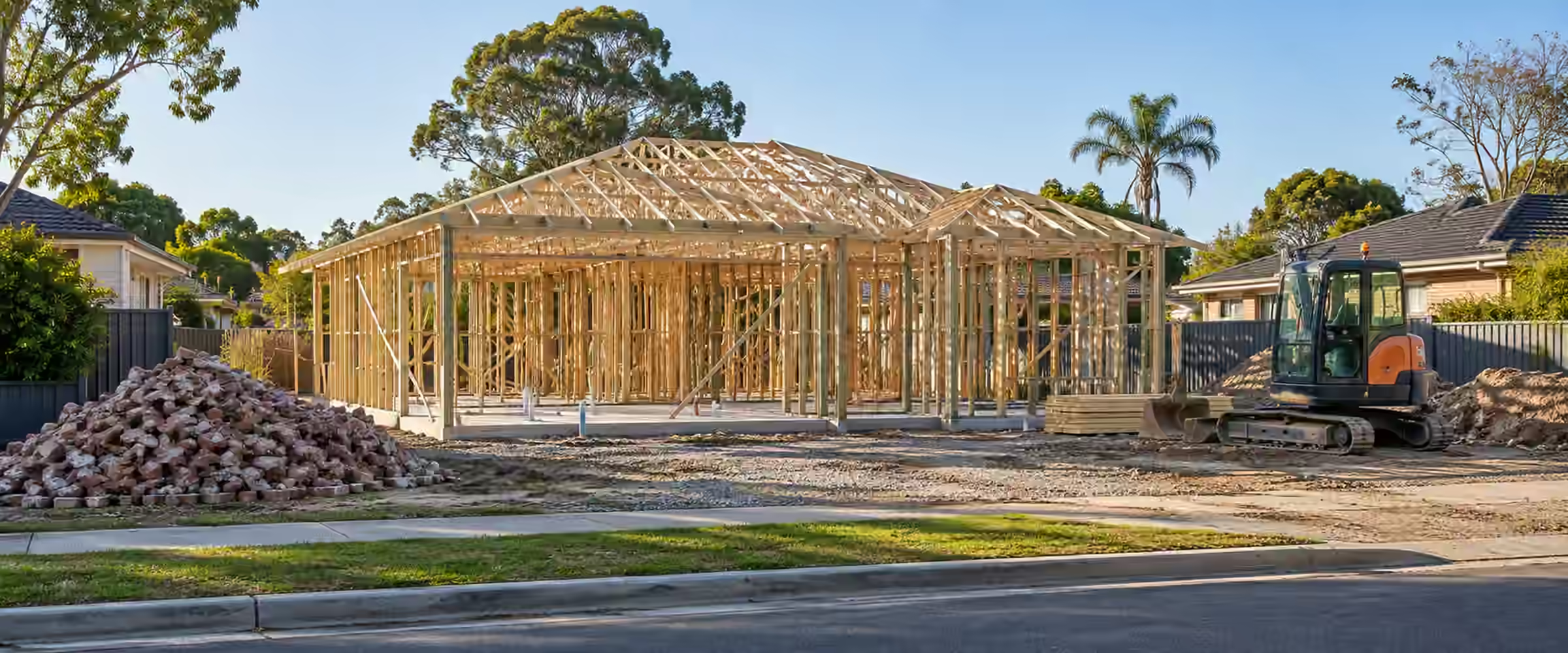
A knockdown rebuild combines two approvals in one project: taking away the existing house and building its replacement. If both the block and its design are eligible, one complying development certificate can cover both.
If complying development is ruled out, for example by heritage or other land constraints, a development application is lodged with council and a construction certificate follows.
Send us your addressOne approval possible
A single CDC can give approval for removing the old house and putting up the new one.
Asbestos first
Asbestos is common in older houses and has to be safely removed before demolition starts.
The lot decides
Heritage, trees, easements and hazard mapping shape what is allowed.
Ends with an OC
You can move back in once the occupation certificate is issued.
Approval pathway
From the old house to the new one
The usual sequence for a knockdown rebuild.
01
Check the lot
We look at heritage, constraints and the design to confirm the pathway.
02
Lodge the application
Demolition details and the new home plans are lodged together.
03
Assessment
Both parts are checked against the standards. Gaps are raised in writing.
04
Certificate issued
Once approved, a principal certifier is appointed and notices are given.
05
Demolish, then build
Services are disconnected and asbestos removed before demolition. The new home is then inspected at each stage.
06
Occupation certificate
The OC is issued once the last inspection is complete and all completion paperwork is in.
Prepare your application
What a knockdown rebuild package needs
Most of this usually comes from your designer and builder. We tell you exactly what your lot needs.
- SurveyExisting site levels, boundary lines, trees and services.
- Demolition detailsWhat is being removed and how the work will be managed.
- New home plansArchitectural drawings and structural engineering for the new dwelling.
- BASIX certificateRequired for the new dwelling.
- Water authority checkConfirmation the new home will not affect water or sewer assets.
Project-specific pricing
Quoted for both stages.
Fees include approving the demolition and your new home, plus the inspections. Everything is quoted in writing.
- Approval pathway
- Size of the new home
- Number of inspections
- Lot constraints
Other building types
Explore other building types.
We certify Class 1 homes and Class 10 structures across our service areas.
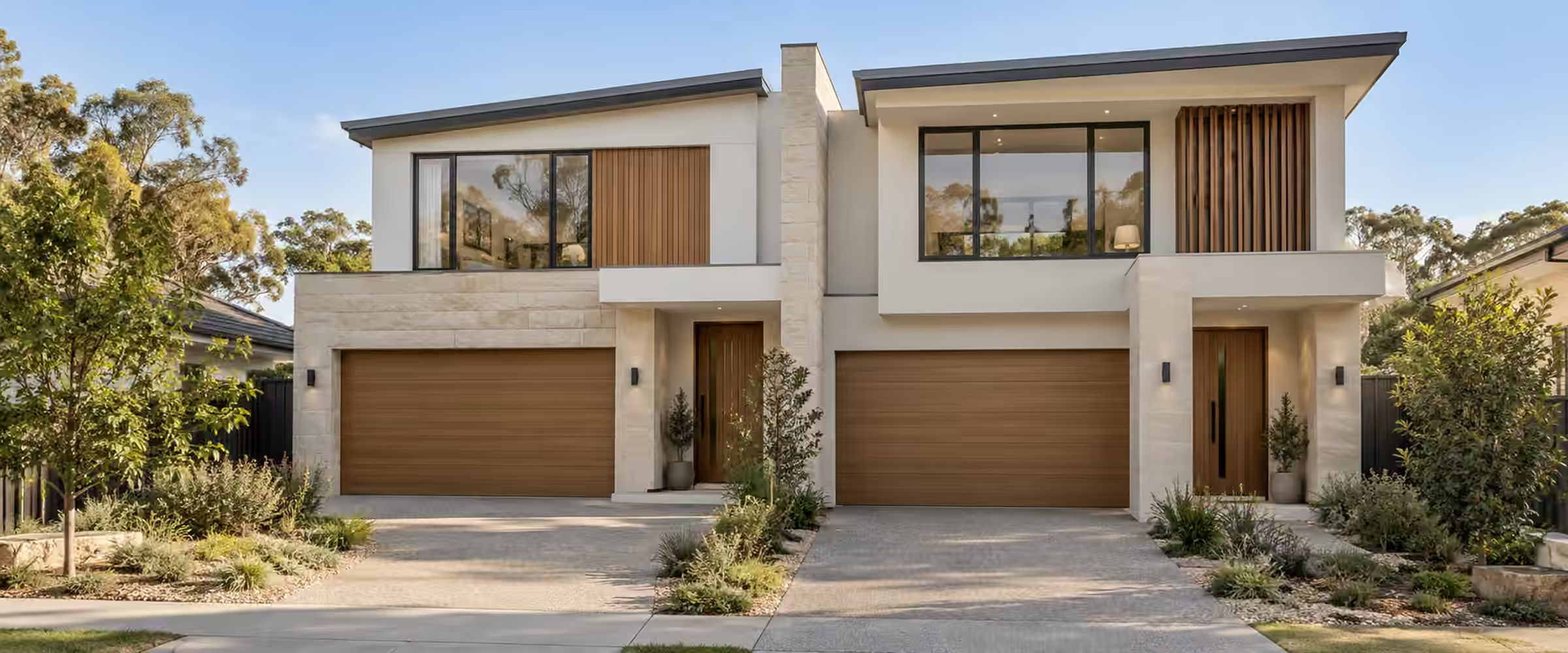

Each job is assessed against the standards for its lot, and we lock in the pathway before your plans are final.
Common issues
What slows a knockdown rebuild
Most delays happen before the new home even starts.
The site
Services not disconnected
Power, gas and water must be disconnected before demolition can begin.
The material
Asbestos found late
Testing early avoids hold-ups once the demolition date is booked.
The lot
Constraints missed
Heritage or easements found late can change the whole pathway.
Before you rebuild
Demolition, asbestos and who to notify
With knockdown rebuilds, the bulk of the rules apply before the new slab is poured. Planning, safety and waste rules all cover taking the old house down.
Sources: NSW Planning Portal: Demolition (complying development); NSW Planning Circular PS 21-036: Asbestos in exempt and complying development; SafeWork NSW: Asbestos notifications; SafeWork NSW: Demolition notifications. General information only; requirements depend on your lot, design and approval.
What does fast-track demolition need?
Demolition can be approved under a CDC (a fast-track approval from a certifier) when it complies with the state demolition rules. The job has to follow AS 2601, the demolition standard. Services must be disconnected as each provider requires. Erosion and sediment controls must keep soil and debris on the lot.
You must notify your neighbours before demolition starts. Contact each service provider early, as some disconnections must be booked and demolition cannot start until they are done.
In a heritage conservation area, or a proposed one, fast-track demolition is very limited. Demolishing the house itself usually needs a development application to council. The same applies where a heritage item sits on the lot. Check the planning certificate and heritage maps before your builder prices the job.
Who can remove asbestos?
Friable asbestos crumbles to powder in your hand when dry. Removing any amount needs a Class A licence. Bonded (non-friable) asbestos over 10 m² can only be removed under a Class B licence or higher. SafeWork NSW recommends a licensed professional even for smaller amounts.
Licensed removalists must notify SafeWork NSW 5 calendar days before work starts. A clearance inspection is done before anyone goes back in. A business removing 10 m² or less without a licence must still follow the code of practice and train its workers. After friable removal, an independent licensed asbestos assessor issues the clearance. After bonded removal, a competent person or assessor can, but they must not be linked to the removal business.
Asbestos conditions on your certificate
Your certificate will carry extra conditions if the work involves any friable asbestos, or bonded asbestos over 10 m². The certifier must get a signed contract showing a licensed removalist will do the work. It must name a landfill site licensed to take asbestos. The landfill must then give a receipt confirming it got the asbestos. An owner-builder cannot remove this asbestos themselves.
Telling SafeWork about demolition
Some demolition also needs notice to SafeWork NSW at least 5 calendar days before. This applies when demolishing a load-bearing part of a structure at least 6 m high, using heavy machinery on a suspended floor, or using explosives. A two storey house can reach 6 m, so ask your demolition contractor early. SafeWork sends an acknowledgement, not an approval, and work cannot start until the 5 days have passed.
Sydney Water before the old house goes
In Sydney Water's area, excavating, demolishing or building on a property needs a building plan approval. It confirms the work will not damage Sydney Water pipes or stop crews reaching them for repairs. Applications are lodged online using Sydney Water's Tap in service, and where work is close to or over a pipe, you are referred to a water servicing coordinator for a detailed assessment.
Disconnecting the old house from drinking water or wastewater services is a separate Tap in application. Approval comes as a letter setting out conditions for the disconnection, which your plumber then follows.
Order the sewer service diagram early in design. A new home with a bigger footprint can reach a pipe that the old house cleared, and moving the house on paper is far easier than redesigning footings once the problem is found on site.
Land that rules out a combined CDC
Whether one CDC (complying development certificate) can cover both the knockdown and the new house turns on the land being eligible. Complying development is generally unavailable for land holding a State Heritage Register item or covered by an interim heritage order, and for land with Class 1 or 2 acid sulfate soils, coastal hazard land, land affected by aircraft noise at ANEF (Australian Noise Exposure Forecast) 25 or above, environmentally sensitive land, or land set aside for public purposes.
Bushfire prone and flood prone land is not excluded outright. Extra standards apply under the code's bushfire and flood clauses, and the new home must meet them in addition to the general Housing Code rules.
A CDC also does not override private covenants on the title. Covenants can control matters such as materials, fencing or how many dwellings a lot may hold, and they continue to bind you after approval, so read the title before design starts.
Trees and work on the street
An established lot often comes with mature trees. The Housing Code sets setbacks to protected trees, and council should be asked before removing or pruning any tree or vegetation. That includes trees the demolition contractor wants gone for machine access.
Anything built beyond your boundary is approved separately. Structures on public land or over a public road need consent under both the Roads Act and the Local Government Act, which can catch a new or moved driveway crossing. Ask council what applies before the site plan is finalised.
A levy paid before approval issues
NSW charges a levy for long service on building and construction work whose cost reaches $250,000, GST included, at a rate of 0.25%.
Payment is due before work begins. A council or certifier is not able to release a CDC or construction certificate while the levy is unpaid. Responsibility for paying sits with the applicant on the approval, or with whoever the work is being carried out for. Holders of a NSW Fair Trading owner-builder permit may qualify for a reduction.
Base the application on a realistic estimate for the whole job, since that cost figure drives the amount payable.
Rebuilding in a mine subsidence district
Parts of NSW lie in mine subsidence districts. Every property in one is given its own surface development guideline, limiting the type, size, height, location and materials of what can be built. The guideline for a lot can be looked up on the NSW Planning Portal's ePlanning Spatial Viewer.
Where a lot has guideline 2, 3 or 3A, or guideline 6 or 8, councils and registered certifiers are able to approve complying development that meets it. Subsidence Advisory NSW itself must approve work that does not comply, and any work on lots with guideline 1 or 1A, or guideline 4, 5 or 7. Guidelines can change over time, so check the current one before design, even though different rules may have applied when the old house went up.
More sources: Sydney Water: Building applications and approvals; NSW Planning Portal: Housing Code; NSW Government: Long service levy for the building and construction industry; Subsidence Advisory NSW: Changes to the development policy framework; NSW Planning Portal: What to tell your neighbours (complying development); NSW Government asbestos website: Unlicensed asbestos removal. General information only; requirements depend on your lot, design and approval.
Your questions, answered
Knockdown rebuilds, explained.
What owners ask before demolishing and rebuilding.
Ask us about your projectCan a single approval cover the knockdown and the rebuild?
Yes, one CDC can approve both taking down the existing house and building the new one, provided each part meets the state's complying development rules, which sit in a State Environmental Planning Policy. The demolition must fit the state demolition rules, and the new home must meet the Housing Code for your lot. Conditions for the demolition, such as the handling of asbestos, are then written onto the certificate. Where either part does not qualify, for example because the property sits in a heritage conservation area, council consent through a development application (DA) is needed instead, and a construction certificate (CC) follows.
Do I need to tell my neighbours?
Yes. In metropolitan areas, neighbours within a 20 m radius are told by the certifier or council before the certificate is issued. Once it is approved, you must give those neighbours written notice before any work, demolition included, gets underway. Metropolitan areas need at least 7 days of notice, while rural and regional areas and residential release areas need 2 days. The notice simply informs them, as neighbours cannot lodge submissions on complying development. Keep a copy of what you sent and when.
Who removes the asbestos?
Friable asbestos, in any amount, can only be taken out by a removalist holding a Class A licence. For non-friable or bonded asbestos, anything over 10 m² needs a licensed removalist with a Class A or Class B licence. On licensed jobs, SafeWork NSW must receive notice from the removalist 5 calendar days before work starts. A licensed removalist is recommended even for small amounts, as no level of exposure is considered safe. The waste must go to a licensed landfill that accepts asbestos, so plan the survey and removal as the first stage of the demolition.
Is rebuilding easier than renovating?
It depends. A new home must comply in full with the current NCC (National Construction Code) and the planning standards for your lot, and the new dwelling must have its own BASIX (Building Sustainability Index) certificate. A renovation is assessed mainly on the new work, and BASIX only applies to alterations with an estimated cost of $50,000 or more. On the other hand, a rebuild removes the unknowns of an old structure and can follow one CDC path if the land allows. Compare the setback, floor area and heritage limits for your lot before deciding.
When is it OK to move back in?
Only after the occupation certificate (OC) for the rebuilt house is issued. Living in or using a building before then is generally not allowed. Your principal certifier can issue the OC after the house passes its final inspection and the paperwork listed in your approval is in. Sometimes a partial OC covers just one section of a building, but only if what remains unfinished is safe for the people moving in. If you need to move in before minor items are finished, raise it with us well before the final inspection.
Services for your rebuild
Related services.
Guidance: the Codes SEPP. What applies depends on your lot, the current house and the new design.
Guides
Knockdown rebuild guides
Knockdown rebuild approvals in NSW: from demolition to move-in
Demolition and asbestos: what to sort before the new house starts
Services, dilapidation reports and neighbours on a knockdown rebuild
Where we work
Knockdown rebuild certification across NSW
We work in 39 council areas, from Newcastle and the Central Coast through Greater Sydney and the Blue Mountains to Lithgow, the Southern Highlands and the Illawarra. Local rules shape every approval, so start with your council or suburb.
Council areas
- Georges River Council
- Kiama Municipal Council
- Lane Cove Council
- Liverpool City Council
- Northern Beaches Council
- Shellharbour City Council
- Sutherland Shire Council
- Wingecarribee Shire Council
Local planning notes by suburb
See all 39 council areasPlanning a rebuild?
Find out how your lot can be approved.
Send us your address and any early concept plans. We'll identify the pathway and provide a written quote.